
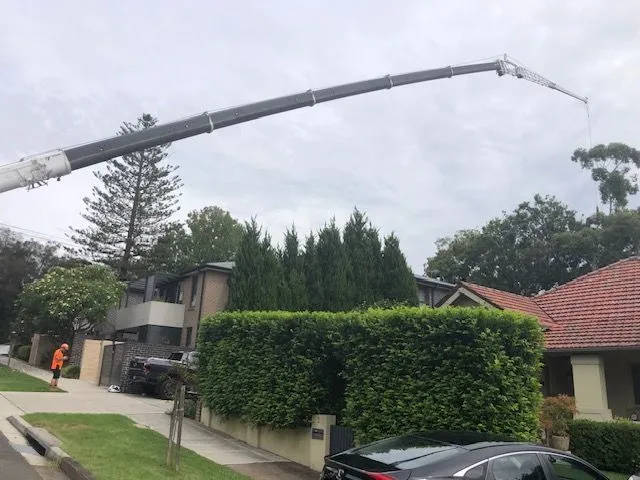
Branches over the fence
The old common-law rule still stands: you may cut branches that overhang your land back to the boundary, but no further, and you don’t need the neighbour’s permission or a court to do it. You normally pay for it yourself.
But council rules sit on top of that. If the tree is protected, pruning it can need a council permit even though the branches are over your side. Some councils go further. Cumberland, for example, requires the tree owner’s written consent plus a permit to prune overhanging branches, and the City of Sydney says pruning a neighbour’s overhanging branches needs an application. As the Land and Environment Court puts it: “Before you prune or remove a tree you must apply for permission from the local council.”
Practical points:
- Talk to your neighbour first. It’s also a legal requirement before the court will make an order.
- Don’t poison or cut roots that could kill or destabilise the tree. That can be illegal clearing, and you could be liable if the tree then fails.
- Cut properly. Pruning to the boundary line can leave stubs that decay. An arborist can often get the clearance you need with cuts that don’t harm the tree.
When a neighbour’s tree damages your property
Under Part 2 of the Trees (Disputes Between Neighbours) Act 2006, you can apply to the Land and Environment Court if a tree on adjoining land has caused, is causing, or is likely in the near future to cause damage to your property, or is likely to injure someone. The court can order the owner to prune or remove the tree, pay compensation, replant, or let you in to get quotes.
What the court needs:
- Evidence you tried to reach agreement. The court must be satisfied you made a reasonable effort first.
- Notice to the tree owner, and to the council if relevant, at least 21 days before the hearing.
- Evidence of damage or likely damage: photos, a plumber’s or engineer’s report, an arborist’s report.
Hearings usually start on site with an arborist Commissioner, and costs orders generally aren’t made. In 2024 the median case took 108 days and 84% had at least one self-represented party. The filing fee is $320 for an individual.
Hedges that block your sun or view
Part 2A covers hedges: two or more trees planted to form a hedge, at least 2.5 m above ground, that severely obstruct sunlight to a window of your home or a view from it. The court can order the hedge cut back, but it can’t award compensation under this part. Lilly pillies, murrayas and leylandii screens are the usual culprits.
What the court won’t do
The court’s published principles say leaf, fruit and small deadwood drop from urban trees ordinarily will not provide the basis for ordering removal. A tree just being big, or blocking a view (as opposed to a hedge), isn’t enough either.
Where to get help
- Land and Environment Court: the Tree Disputes Student Helpdesk is free.
- Community Justice Centres no longer mediate most neighbour disputes. Since 1 July 2025, CJC mediation is limited to court-referred matters and incorporated associations.
- An arborist’s report is often the most useful evidence. The court expects experts to be independent and to follow its expert code of conduct.
If you and your neighbour agree the tree should be pruned or removed, we can quote the work and tell you whether the council needs to approve it.